Octopuses are fascinating creatures that have captured the imagination of scientists and marine biology enthusiasts alike. Their complex anatomy and surprising behavior make them some of the most intriguing animals in the ocean. In this article, we’ll explore the key question: How many brains does an octopus have? and discover other interesting aspects of their biology.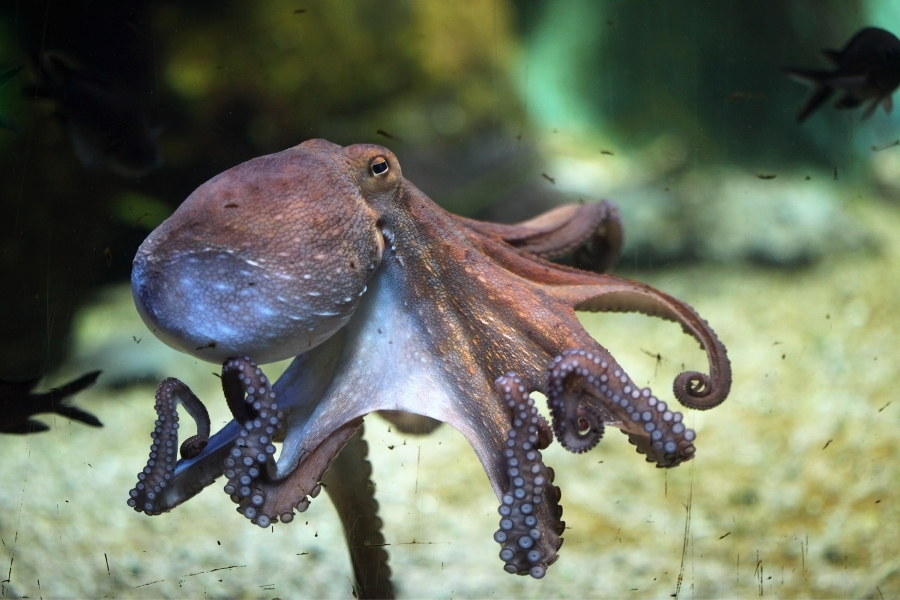
How Many Brains Does an Octopus Have?
The answer to the question How many brains does an octopus have? is more complex than it might seem. An octopus has one main brain, located in its head, which is responsible for most of its cognitive functions. However, what many people don’t know is that each of its eight arms also contains a “mini-brain.” This distributed nervous system allows octopuses to perform multiple tasks at the same time.
An octopus’s central brain contains around 500 million neurons, while each of the “mini-brains” in its arms contains approximately 40 million neurons. This means that octopuses can have close to 520 million neurons working together in total. This unique structure allows them to coordinate their movements effectively and respond quickly to their surroundings.
An octopus’s brain also has a different structure from that of vertebrates. Rather than being protected by a skull, it is surrounded by the octopus’s soft body, allowing it to remain highly flexible and adapt to various situations.
How Many Hearts Does an Octopus Have?
Octopuses have a unique circulatory system. An octopus has three hearts in total. Two pump blood to the gills, where it is oxygenated, while the third pumps the oxygenated blood to the rest of the body.
This adaptation is vital to their survival in marine environments, where they need a constant supply of oxygen to stay active. Octopus blood is blue because it contains hemocyanin, an oxygen-carrying protein that works more efficiently than hemoglobin in low-oxygen conditions.
The connection between an octopus’s hearts and brain is also interesting. When an octopus swims, one of its hearts temporarily stops beating, allowing it to conserve energy and adapt to its surroundings more efficiently.
Can Octopuses Feel?
Octopuses have a highly developed nervous system that allows them to sense and respond effectively to their surroundings. Their skin is extremely sensitive, enabling them to detect changes in temperature, pressure, and texture. They also have specialized cells called chromatophores that allow them to change color and camouflage themselves, which is essential for their survival.
Octopuses’ sensory perception is not limited to their skin. They also have exceptional vision, with eyes that can detect different wavelengths of light. This helps them navigate their surroundings and locate prey.
Their advanced sensory system and ability to learn have led octopuses to be considered among the most intelligent animals in the ocean. They can solve problems, learn from experience, and display complex behaviors, making them a fascinating subject of study in the field of animal intelligence.
What Is an Octopus’s Brain Like?
An octopus’s brain is remarkably different from that of vertebrates. It has a ring shape that surrounds the octopus’s esophagus, a feature unique in the animal kingdom. This brain is divided into several lobes that specialize in different functions, such as vision, memory, and motor control.
In addition, the octopus’s brain is made up primarily of neurons, unlike vertebrates, which also have a considerable number of glial cells. This design allows neurons to communicate more efficiently, enabling the octopus to respond quickly to external stimuli.
One interesting feature of the octopus’s brain is its ability to adapt and learn from its surroundings. Studies have shown that octopuses can remember past experiences and use that information to solve future problems. This suggests a level of intelligence comparable to that of some mammals.
Octopus Intelligence
Octopus intelligence is one of the most remarkable aspects of their biology. These animals have been shown to be able to:
- Solve complex mazes and puzzles.
- Use tools to obtain food.
- Change their behavior based on past experiences.
These behaviors not only demonstrate their ability to learn but also reflect a high level of adaptability. Octopuses can develop sophisticated hunting strategies, using their surroundings to hide and catch their prey.
The study of octopus intelligence has raised new questions about how intelligence is defined in the animal kingdom. Compared with other animals, octopuses display a very different kind of intelligence because their brains and nervous systems are organized in a unique way.
More Amazing Facts About Octopuses
Octopuses are full of surprises. Some of the most interesting facts include:
- Their ability to change color and texture, which helps them camouflage themselves and communicate.
- They can regenerate their arms if they lose them, a process that helps them survive predators.
- They have short lifespans; most octopus species live for only between 1 and 2 years.
These traits highlight not only how unique octopuses are, but also how well they have adapted to a constantly changing marine environment.
More Fun Facts About Octopuses
There are many other fascinating facts about octopuses. For example, some can produce ink as a defense mechanism. The ink not only darkens the water but can also irritate predators.
In addition, some species, such as the blue-ringed octopus, are highly venomous. Their bite can be fatal to humans, which is why it’s important to be cautious around them.
Another interesting fact is that octopuses have a peculiar life cycle. After reproducing, the female usually dies shortly after caring for her eggs, reflecting the sacrifice she makes to ensure the continuation of her species.
Related Questions About Octopus Biology and Behavior
Does an Octopus Have 3 Hearts and 9 Brains?
An octopus does indeed have three hearts and one main brain, as well as “mini-brains” in its arms. This means it has a highly developed nervous system that allows it to perform multiple functions at the same time.
What Marine Animal Has 8 Hearts?
No marine animal with eight hearts has been documented. Octopuses have unique anatomy in this respect, with three hearts instead of eight. However, other marine animals have interesting circulatory systems.
Does an Octopus Have 3 or 9 Hearts?
Octopuses have a total of three hearts. Two pump blood to the gills, while the third pumps blood to the rest of the body. This adaptation is crucial to their survival in the ocean.
What Animal Has More Than One Brain?
The octopus is one of the few animals with more than one “brain.” In addition to its main brain, each arm contains a mini-brain. Other animals, such as some types of flatworms, also have complex nervous systems, but the octopus stands out in the animal kingdom.